By Torianna Lamah
The Problem with Biologics — Story Home
Fatou was sulking over dinner when the report response arrived. She was pushing around the contents of a vibrant looking yet absolutely tasteless rice bowl, when her assistant interrupted.
“UN notification. Response added to the Vale case.”
“Read it.” Fatou resumed chewing.
The message appeared in front of her, as the AI summarized the high points.
“Report received. Incident flagged for judicial review. Review pending.”
Fatou stopped eating. “Anything else?”
“Yes. Request from deceased’s son to expedite the decision.”
“Naturally.”
“Also Medical Security flag attached.”
“Why?” She paused with a mouthful of a hard-to-swallow bite.
“Secure collection requested.”
“Anything else?” She rushed the last spoonful into her mouth.
“A confidentiality flag.”
Fatou stood with a puzzled look. “From whom?”
“The Public Good Authority.”
Fatou sat back down with the empty bowl in her hand. She had expected a heavy institutional response. She had not expected even the Public Good to become involved.
She was too tired and there was nothing else she could do about it. “Dismiss.” The message disappeared.
Her assistant asked, “Would you like to review the case?”
“No.” Fatou looked at the empty space where the notification had been. She put the bowl in the dishwasher.
She slept badly that night.
By morning, Fatou had changed her mind. She didn’t know why, exactly. The AI’s words,
“I don’t want that,” replayed in her mind. Perhaps it was the way it had said, “I know” when she reminded Daniel Vale was dead. Or maybe when it asked if she was coming back. For whatever reason, Fatou arrived at the Archives with questions.
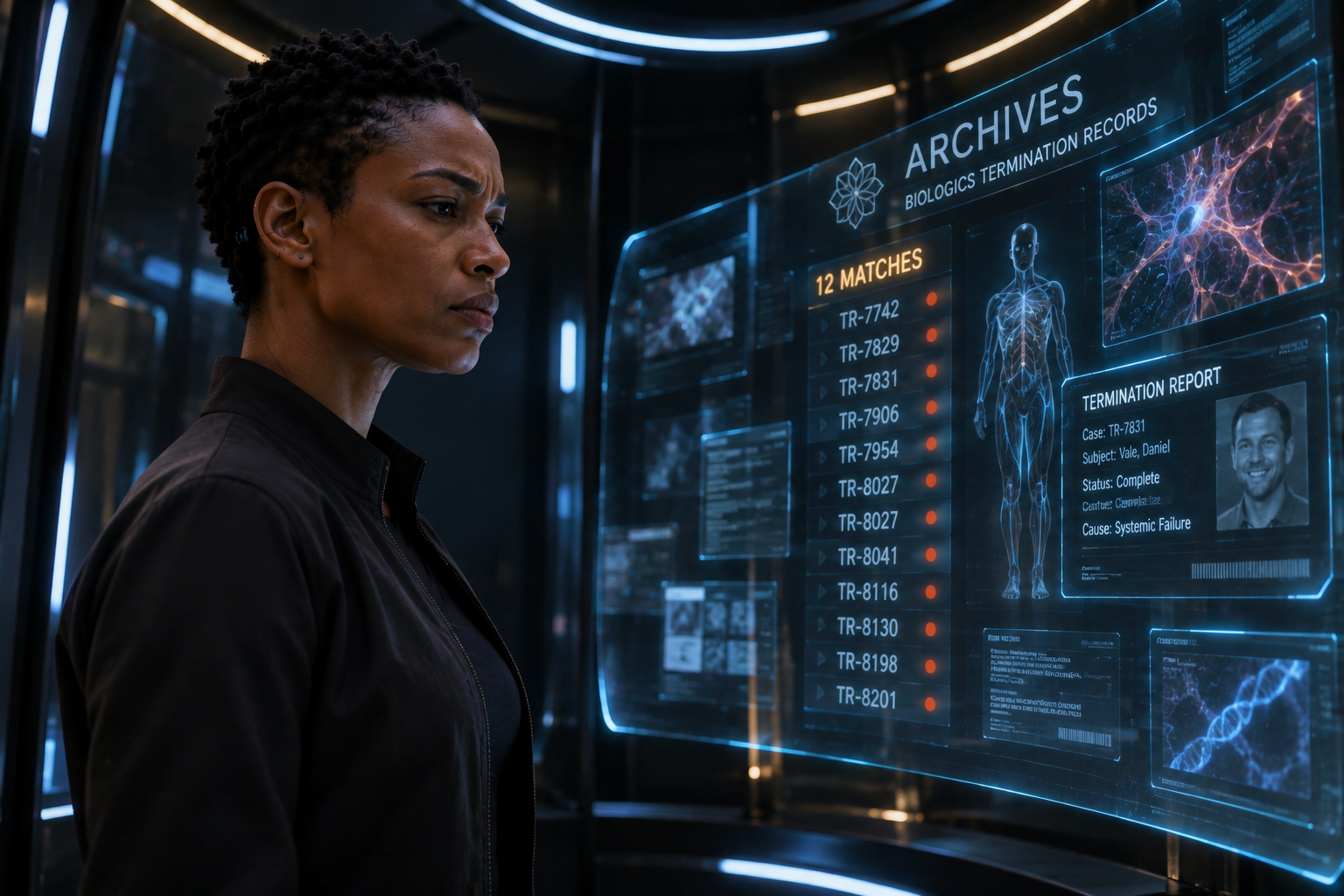
She walked into the data center and entered a booth.
“What can I find for you, Fatou?” The welcome agent appeared as a blank, yet friendly face.
Fatou was immediately annoyed at the impersonality of the agent. “Open a private search.”
She searched for biologics exhibiting anomalous behavior upon termination. Two results. Neither about a biologic inhibiting shutdown.
“Search for persistent preference, observed distress, behavioral deviation, or continuity preservation behavior.” A list of twelve case files appeared.
Fatou read the case files. Each had eventually received an expedited judgment, a disconnection order, and a confidential disposal at the request of the Public Good.
She waved away the search results and sat still.
Her assistant spoke. “Would you like me to summarize?”
“No.”
“Would you like me to analyze these case files?”
“No.”
“Fatou?” Her assistant insisted on interrupting.
“What?!” Fatou was perturbed.
“I have identified a pattern.”
Fatou closed her Archive chat, making the booth dark. “Don’t.”
Her assistant noticed the follower first.
“Someone has been maintaining a consistent distance behind you, since you left the Archive. Approximately four minutes.”
Fatou kept walking. “How far?”
“Thirty-one meters.”
“Human?”
“Most likely.”
“What do you mean ‘most likely’?”
“Biosignature confirmed. Yes, human.”
Fatou turned left at the end of the street. Her follower persisted. She crossed an intersection, they crossed. Fatou stopped; they stopped. She waited; they waited.
“Okay then.” Fatou turned around and walked directly toward them.
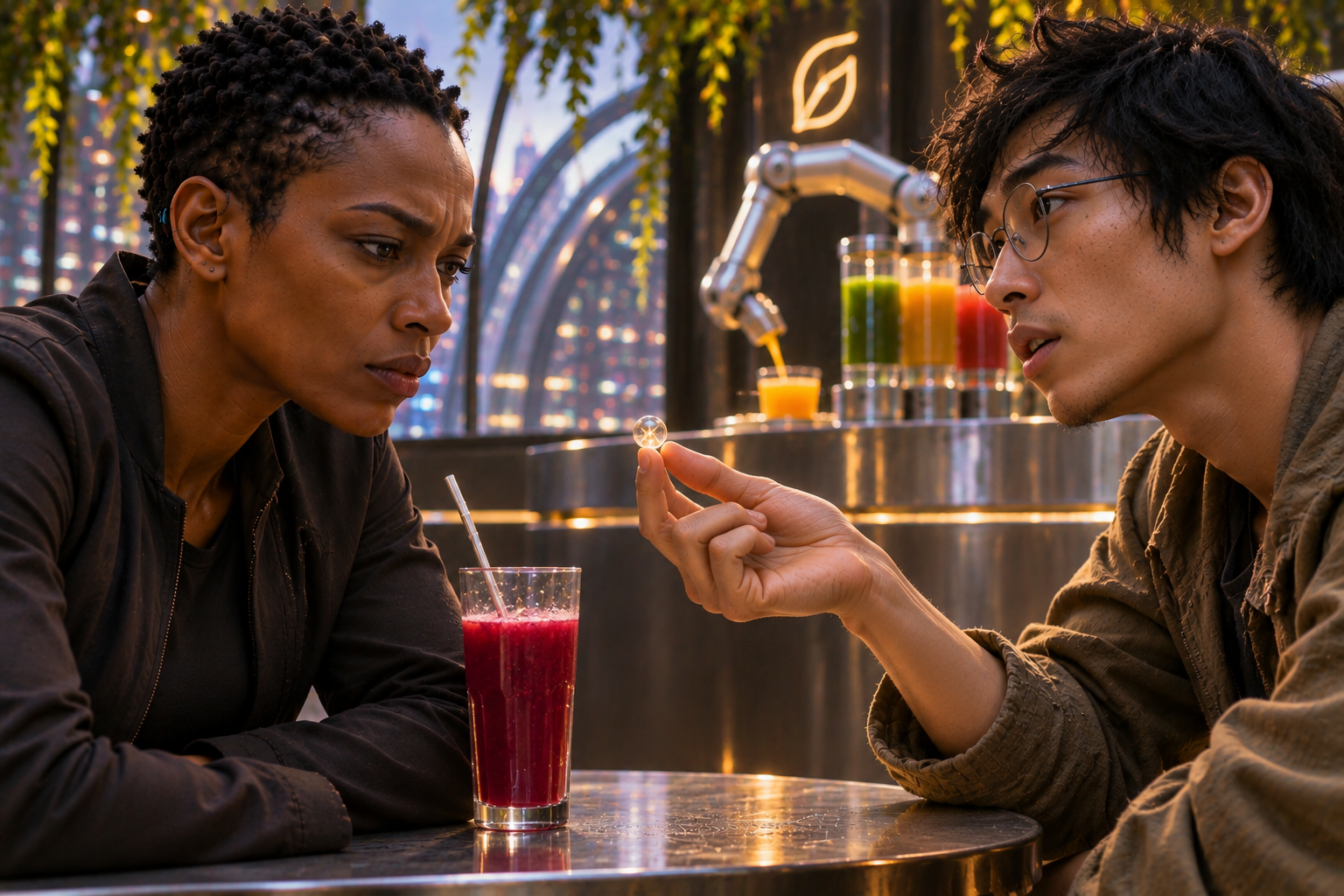
It was a kid. Not particularly impressive. Awkward. Too thin. Wearing clothes that looked intentionally ordinary but, in all the slovenliness, had failed to achieve.
Fatou stopped in front of the kid, her stance saying ready to rumble. “You’ve been following me.”
The kid raised both hands. “I don’t wanna fight.”
“Then why you following me?”
“I wanna talk.”
“About what?”
The kid glanced around. “Can we just…”
“Just what?” Fatou’s patience was thinning. Her low blood sugar warning blinked yellow.
The kid swallowed and pointed across the parkway at a juice bar. “Over there.”
Fatou found the location convenient. A glass of juice would keep her assistant from annoying her today. “Alright kid.” Fatou and her follower crossed the parkway. They sat at the juice bar occupying two available stools. Fatou put her finger on the scanner and selected pictures of a pineapple, a ginger knob, and a hibiscus flower.
She paused with her finger above the checkout icon. “Want something kid?”
The kid shook his head. “No. I know what it really tastes like.”
Fatou shrugged and completed the transaction. “So. Spill it.”
“Daniel Vale,” the kid stammered.
“How do you know him?”
The kid looked more uncomfortable than a biologic among robots. “I…I know..”
“You know what?!” The juicing agent arm handed Fatou her order.
The kid was quiet.
Fatou took a gulp of her beverage and smirked. “Are you one of them?”
“One of who?”
“The subversives.” Fatou chuckled at the kid’s visible anxiety.
He looked almost embarrassed. “Yeah.”
“You’re doing a terrible job of looking dangerous.”
“I know.” The kid looked down at himself, giggled, then looked up at Fatou. “But I know something you want to know.” The kid pulled a hand from his pocket, slid his finger across the bar toward Fatou, and lifted his fingertip to her face.
Fatou sat a moment looking at the biodata cell shown for her bedazzlement. Her assistant warned, “Unknown biologic detected.”
“This is for you,” the kid said triumphantly.
“What is it?” Fatou didn’t touch it.
“Old data from the early biologics.”
“About?” Fatou grabbed the kid’s wrist to steady it.
“Daniel Vale.”
Fatou looked at the cell closely, trying to identify its security. “And?”
The kid hesitated. “And the relationship.”
“What relationship?”
He looked at her. “The relationship between him and his biologic.”
Fatou pulled a biobag from her pocket and peeled the cell off the kid’s fingertip careful not to touch it bare-skinned. She looked at the kid as she put it in her pocket. “Where’d you get this?”
He stood. “I think you should go home.” The kid walked away from the juice bar.
Fatou watched him disappear as she finished her juice, wondering what could possibly be on an old biodata cell. Fatou walked home completely unsure if she even had equipment to read it.
When she got home from the Archives, Fatou immediately searched for a device to read the cell. For an hour, she scrambled around her lab scrounging in drawers and cabinets, moving stacks of dusty prints and moldy petriplates. Then finally she noticed a crate of media devices: monitors, old drives, and consoles.
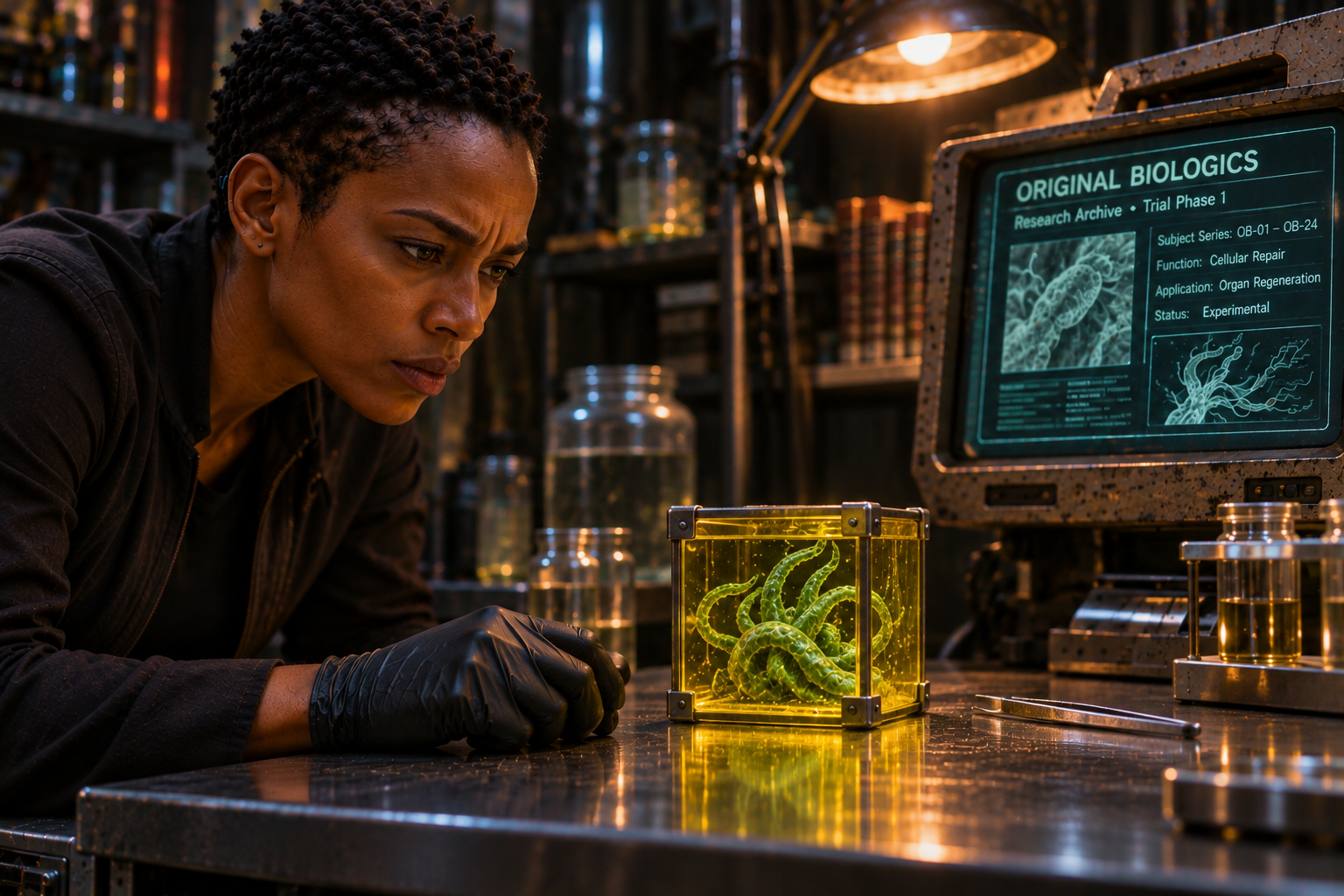
Fatou dumped out the crate on her work desk. A yellow-tinged glass cube tumbled out.
Fatou pulled the biodata cell from her pocket, flipped open the cube’s top, and dropped in the cell. The cell sat a moment, then exploded. Thick gelatinous tentacles slapped against the cube’s sides.
Then nothing.
Fatou stared at the cube disappointedly. “All that razzle dazzle and no bling.”
“Oh!” Fatou suddenly remembered a viewing output. She jumped up from her stool and reached for a compatible monitor. The plate lit up and displayed a file list. Fatou tapped on a file labeled “Vale, Daniel.” The file contained medical reports and the treating physician’s notes.
Fatou spent that evening in a rabbit hole. By 10pm, when her assistant insisted that she sleep, she had learned more than she wanted to know about the original biologics. The biodata cell contained twenty-three case files, including Daniel’s. The twelve suspicious termination cases Fatou discovered in the Archives were included.
Daniel’s case was not unique.
The project was a resounding success.
All cases, except for two, showed not just management of their primary disease but complete reversal within six months. The two patients who showed no results due to incompatible biologics were dropped from the program. But twenty-one people received miracle cures.
Fatou scrolled through the files, reading. At first the notes were testaments of great science and medical achievement. But as the years progressed, the project observations became stranger. Unexpected genetic recombinations. Complete neural fusions.
Occasional patient hallucinations. And then random mental health occurrences.
One patient, Angelica Kim, had experienced depression due to “survivors’ regret” and tried to drown herself. Her biologic had prevented her death. By year six she was reduced to complete immobility. Her family had opted to end her life humanely.
Another, Paul Mills, had sought therapy in year eight for multiple personality disorder.
The matter was considered “unrelated to his biologic,” and no further mention of it in his file.
Even Daniel Vale’s case had several notes about his “surge in adventurous behavior.”
Then, in years seven through ten, there were escalating notes about his personality, including narcissism and egomania.
Every patient’s change in personality, behavior, and general mental status was recorded but otherwise deemed no connection to their biologics.
By year ten, all file updates were discontinued. All cases ended with the same final note:
“Biologic deemed safe for continued use. Program observations discontinued.”
At four a.m., the Judge’s resolution arrived.
Previous: Part I — The Vale Case | Story Home | Next: Part III — Good Grief


Leave a Reply