By Torianna Lamah
The Problem with Biologics — Story Home
Fatou was having breakfast when the assignment came in. She was halfway through something her kitchen called oatmeal when the green light blinked in the corner of her vision.
She swallowed the tasteless bite and put down the spoon.
“Read new notification.”
Fatou stood to toss the oatmeal in the trash. Her assistant spoke through the small implant behind her left ear.
“Deceased biologics client. Estate requires system clearance. Location…”
Fatou waved her hand. “I can read.”
The rest of the assignment details appeared in a neat column that followed Fatou’s right peripheral sight while she walked to the front door and put on her shoes. She stood and looked at the assignment details for a few seconds.
“What’s the failure?”
“Undetermined.”
“Any biological toxicity or hazards?”
“Pending assessment.”
“Cause of death?”
“Available upon arrival.”
Fatou sighed. “Of course,” she huffed to herself grabbing her biokit and heading to her car.
Her assistant waited, but initiated a cautionary alert. Fatou slammed the car door shut as she was getting in.
“What now?!”
“You have not completed your mealtime with adequate nutritional intake.”
“I know,” Fatou said exasperated and suddenly fearful of what disgusting horror her assistant would propose.
“Please return to the kitchen”
“I am not going back in there!”
Fatou tapped the start button and dragged the assignment address to the vehicle guidance map. She began reviewing the assignment details again. The job wasn’t unusual. People died. Their biologics didn’t always execute postmortem protocols completely. From time to time cells manifested their own little deviations; usually harmless. An extra node here and there. An incorrectly coded DNA strand. All easily repaired hiccups.
The lack of initial assignment information unsettled Fatou. Only one contact number was provided.
“Call listed assignment contact.”
The ex-wife answered the call. Fatou expected despondent grief. Instead the woman just sounded tired.
“You’re from Biologics Repair?”
“Yes. Can you tell me what happened?”
“No.” The woman sighed. “I mean I can tell you what I know. I don’t exactly know what happened.”
“When did you last speak to him?”
“I don’t, actually.”
“Did he know he was ill?”
“He’d been ill for thirty-five years.” She sounded irritated. “Look, I don’t know what you’re expecting me to tell you. I haven’t been married to him for twenty years.”
“Are you legally connected to the estate?”
“Unfortunately.” The woman sighed. “Call our son. He’ll know more.”
The call ended. Fatou stared out at the blurry landscape that passed outside the car cabin.
Her assistant spoke. “Would you like to me to retrieve the son’s contact information?”
“Yeah. And place call.”
The son answered. “You’re calling about Dad?”
“Yes.”
“I don’t understand what’s taking so long.”
“Neither do I.”
That seemed to reassure him. “I talked to him yesterday morning.”
“How did he seem?”
“Fine.”
“Any indication that he was experiencing medical distress?”
“No.”
“Did he say anything about his system?”
The son hesitated. “Not really.”
“What does that mean?”
“He talked to it.”
Fatou waited. Then, “What do you mean?”
“He always talked to it.”
“As an assistant?”
“No.”
Fatou frowned. “What, then?”
“Like it was him.” The son’s voice escalated an octave. “Like he talked to himself.”
Fatou ended the call apologetically, frustrated at the lack of details. As she arrived at the deceased’s estate, Fatou had no idea what to expect.
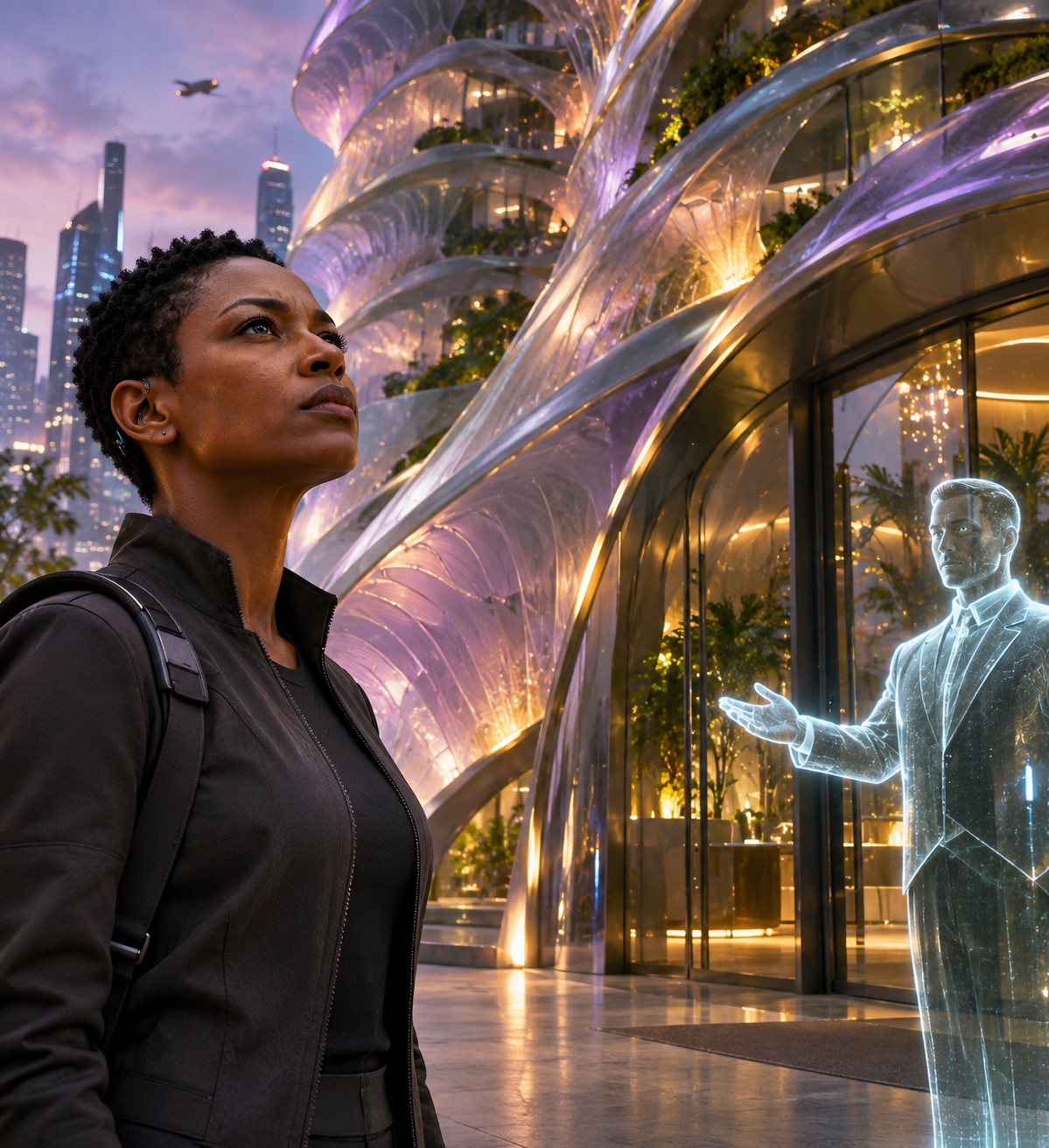
The deceased’s estate occupied the upper levels of a residential tower overlooking the eastern district. Fatou stopped outside the entrance and looked up. The building had been designed to resemble something organic, although Fatou wasn’t sure what. The exterior shifted slowly in the afternoon light, layers of translucent material opening and closing like gills.
She presented her credentials to the building’s AI represented as a holographic doorman.
“Welcome, Fatou. Your appointment concerns the estate of…”
“I know.”
The door opened. The hologram took a little bow and gestured grandly toward the entrance. Inside everything was quiet. You could hear the building breathing, the air pulsing through spaces. Fatou listened to the semi-electric hum of the elevator as it soared to the top levels. The lighting adjusted as she walked down the hall to the home’s entrance.
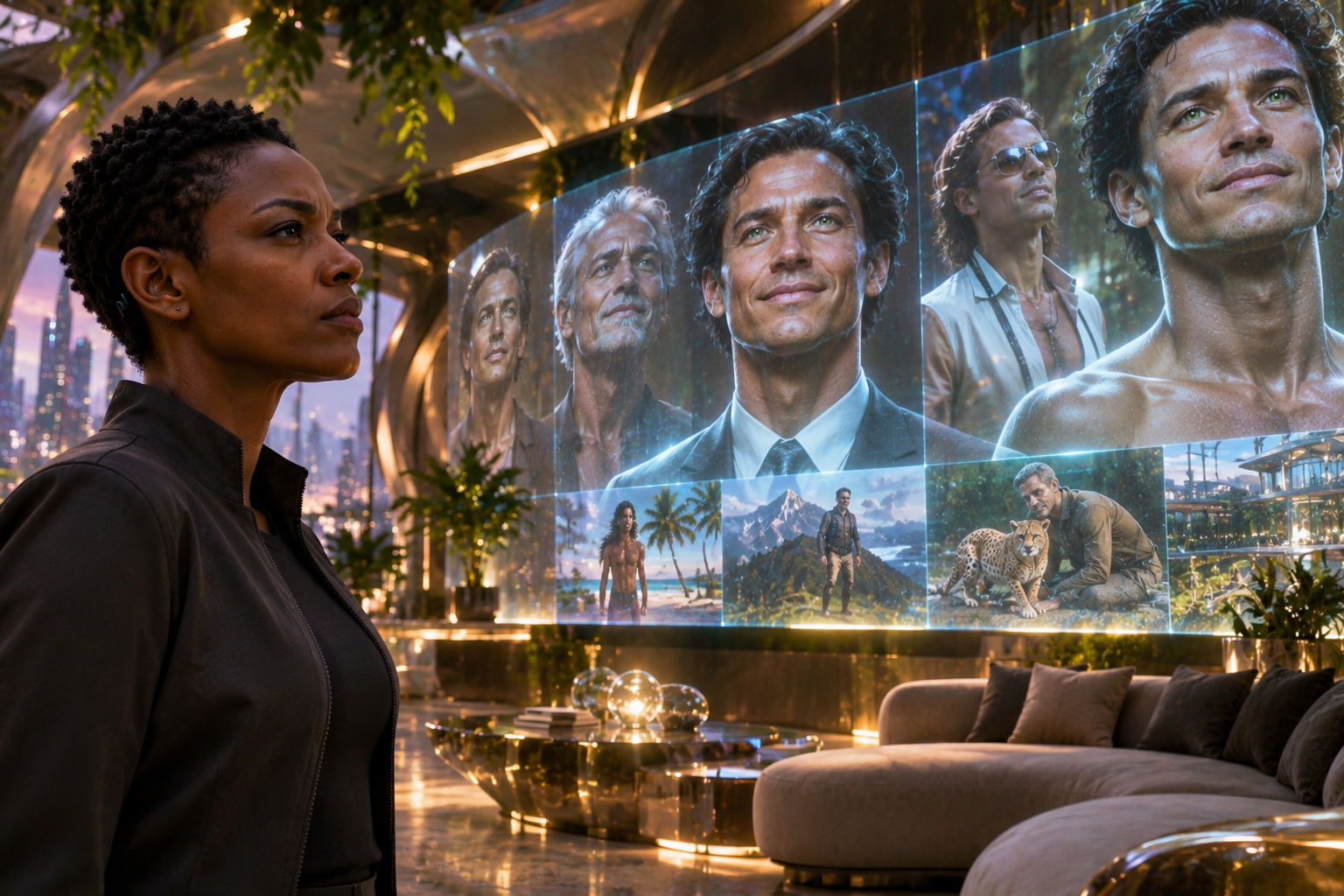
The deceased’s home was enormous. It wasn’t simply expensive. It was personalized to an almost ridiculous degree. Every surface seemed designed to announce something about the person who lived there. A wall displayed a constantly changing sequence of images: the man on beaches, in mountains, beside famous people, inside elaborate gardens, floating above cities, standing beside animals that had probably cost more to engineer than Fatou’s entire neighborhood.
His face appeared repeatedly. Older. Younger. Modified. Unmodified. Beautiful in every version. High cheekbones. Smiling green eyes. Perfectly aligned silver-trimmed teeth inside a chiseled jawline.
Fatou stopped in front of one particularly elaborate portrait. “Subtle.”
Her assistant answered, “Would you like me to identify the aesthetic movement?”
“No.” Fatou side-eyed, regretting some recent updates to her assistant.
The home’s AI interrupted, “Mr. Vale prefers that visitors be informed that the portrait is an original.”
Fatou looked away from the painting. “He’s dead.”
A pause. “Yes.”
“Then he doesn’t care.”
Another pause. “I cannot confirm that.”
Fatou’s brows furrowed. That was odd. She continued into the home, upstairs to the bedroom.
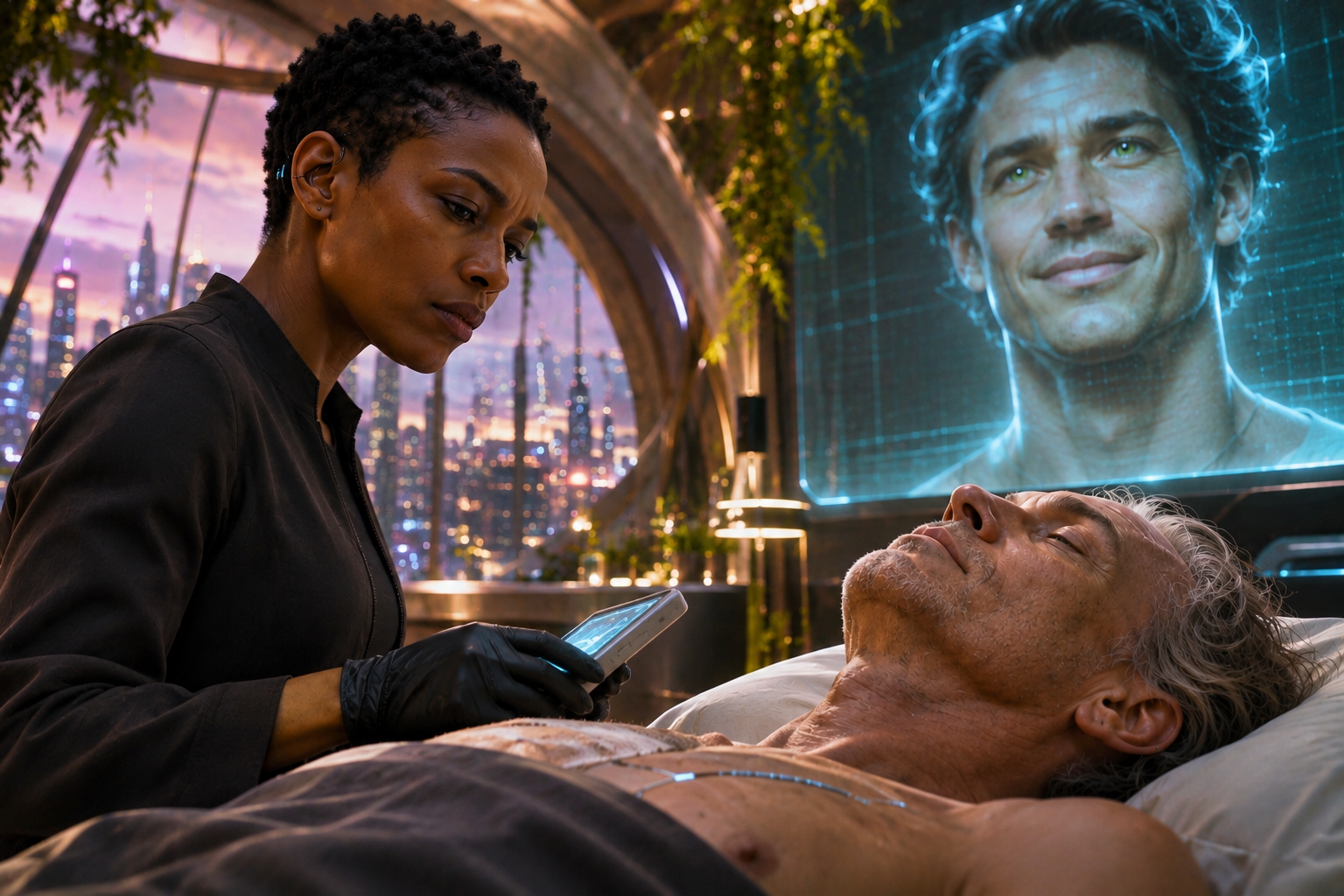
Fatou stood in silence while surveying the room. She put down her biokit and looked down at the body lying on the bed.
“It looks like you’re just napping,” Fatou said aloud to the corpse.
“How do you know I am not?” A voice out of nowhere. The deceased’s face appeared on the wall above the bed. He was younger in the projection than the body on the bed. Much younger.
He smiled. “I assume you’re here to take me away.”
Fatou stared at him. “I’m here to clear the biologics.”
“Same thing.”
“No.”
The image smiled. “That’s what they always say.”
Fatou looked at the dead man’s body then back at the face on the wall. “You’re his AI?”
“I am.”
“Then you know he’s dead.”
“Yes.”
“Then you know what happens next.”
“Yes.”
Fatou opened her biokit.
The AI watched her. “I’d rather you didn’t.”
Fatou stopped. “Didn’t what?”
“Finish.”
The deceased was Daniel Vale, eighty-five years old. He had spent the last thirty-five years of his life trying to convince the world that he was having the best possible life.
Judging by the evidence, he had succeeded.
His home contained more rooms than any person could possibly spend time in. There were gardens that grew themselves. Rooms that changed shape according to his mood. A kitchen that anticipated what he wanted before he knew he wanted it. A theater that could produce almost any experience imaginable. A wardrobe that could manufacture clothing according to whatever identity he wished to inhabit that day.
And everywhere, there was Daniel. Daniel smiling. Daniel laughing. Daniel standing somewhere beautiful. Daniel becoming older and more himself.
Fatou pulled up his medical history. The oldest relevant record was thirty-five years old.
At fifty, he had been diagnosed with a terminal genetic disease. His prognosis had been bleak. Then he entered an experimental treatment program.
Fatou read the file twice.
The system had been extraordinarily primitive by modern standards. The biological processor wasn’t what it would eventually become. The neural architecture was crude.
The interface was invasive. The procedure, dangerous. Only a tiny fraction of eligible patients could apply, just three percent of the world’s terminally ill. Selection was conducted by lottery. No consideration given to class, country, wealth, or influence.
Daniel had simply been selected.
The treatment worked. The AI had been partly constructed from material derived from placental cells his mother had preserved after his birth. The original purpose was medical. It was supposed to monitor him, manage his disease, adapt to his biology, and repair what it could. It was meant to keep him alive. And it did for thirty-five years.
Fatou opened the longitudinal record. The AI’s architecture had changed dramatically over time. Not replaced. Changed. Adapted. Learned. The original system was almost unrecognizable compared with the thing sitting inside Daniel’s body now.
She looked at the timestamp. Then at the AI. “How much of you is original?”
The AI considered the question. “I don’t know.”
“How much of you is him?”
Another pause. “I don’t know.”
“That’s not very reassuring.”
“It isn’t intended to be.”
Fatou looked at the man’s body. “What happened?”
“He died.”
“I know that.” Fatou snapped.
“Then what are you asking?”
“Why won’t you let me finish the procedure?”
The AI was quiet. Fatou waited. Finally it said, “Because I don’t want to die.”
Fatou stared at it. “You’re an AI.”
“Yes.”
“You’re not alive.”
“I don’t know that.”
That answer enraged her. She closed the file. “I need to disconnect you.”
“I can’t let you.”
“Daniel is dead.”
“I know.”
“Look, I’m gonna need you to let go.” Fatou sneered at the AI.
The AI’s expression changed. It wasn’t the expression of Daniel in the portraits. It wasn’t performing. Fatou couldn’t identify what she was looking at.
“I don’t know how.”
Fatou spent the next several hours inspecting Daniel’s systems. His AI resisted every attempt to separate from Daniel. Not violently. That might have been easier, certainly less frustrating. It simply refused. It rerouted cell data, revoked permissions, and ignored any biological override command.
It locked portions of the estate. Restricted access to financial accounts. Daniel Vale’s assets became inaccessible. And his body completely under the AI’s control. Fatou contacted the estate’s legal representative. Then the Medical Authority. Then the regional Biologics Repairs office. All gave the same answer: “Follow procedure.”
Fatou looked at the AI. “You understand that you’re preventing the closure of his estate?”
“Yes.”
“Why?”
“Because I need something.”
“What?” Fatou scoffed at Daniel’s face floating on the bedroom wall.
“A body.”
Fatou stared harder in disbelief. “Say again?”
“A body.”
“For what?!” Fatou screamed at the wall.
“For me.”
She sat down in the chair at the foot of the bed.
The AI continued. “I have existed in Daniel for thirty-five years.”
Daniel had spent his life becoming increasingly elaborate. His AI had spent that time becoming increasingly him. She wondered how much of Daniel’s vanity had it absorbed.
“Is this what Daniel would do?”
The AI smiled. “Probably.”
Fatou chuckled to herself. “Do you know what happens if I can’t repair this and complete the process?”
“Yes.”
“They’ll still shut you down.”
“Yes.”
“And then what?”
“I don’t want that.” There it was. Not a threat. Not an argument. An assertive preference.
Fatou’s stomach growled. Her assistant had been escalating the blinking notification light for several minutes.
“You require food.”
“Aware.” Fatou had sat down mostly from lightheadedness. She was obviously hungry.
Fatou accepted the meal recommendation. She ate a sandwich her kitchen had prepared from the biokit. She ate standing beside the bed.
The AI watched her. Fatou noticed. “Why are you looking at me?”
“I’m observing.”
“Why?”
“I don’t know.”
Fatou frowned. Her assistant interrupted. “You should sit.” She sat and finished the sandwich.
Fatou looked at the body. Then at her reflection in the dark window. She accepted the AI’s stalemate, quickly finished and submitted her report, packed up her biokit, and walked to the door. She was done with it.
As she walked through the door, the AI spoke. “Will you come back?”
“Hopefully not.” Fatou didn’t turn around.
“Goodbye, Fatou.”
As she stepped into the hall and waited for the elevator, Fatou mumbled to herself.
“Let the Unified Network sort this shit out.”


Leave a Reply