NDWOMARA · INSTALLMENT 02: Establishment of Ndwomara
Listen to the story
Ndwomara was founded in a place where the Song vibrated best.
The land itself was receptive—its geography, climate, and underlying resonance allowing the Song to gather rather than dissipate. Birds tweeted in harmony with it. Leaves and grasses rustled, giving its measures texture. The hearts of beasts beat to its rhythms. The Song bloomed in this place. And the wind carried it to far reaching lands.

Those born with talents were drawn to it across great distances. Some arrived as fugitives from lands where their gifts were rare and feared, escaping persecution or forced suppression. Others came without threat, compelled instead by nagging curiosity, a sense of unfinished listening. Their reasons differed, but their destination did not.
They all came because of the Song.
The settlement that formed around this convergence did not name itself. Ndwomara was a name given by the peoples of the lower lands, who observed the growing community from outside its borders. In their language, the name reflected how the place was understood: not as a kingdom or city, but as a locus where everything was so in balance that the place itself sang.
As the rhythms of the Song spread, Ndwomara grew beyond a single settlement. Immigrants from neighboring lower kingdoms—and eventually from far beyond—were drawn to its resonance. Over centuries, independent kingdoms chose to join the growing empire, not through conquest but convergence. With each addition came new knowledge, innovations, artistic traditions, and wealth, shaping Ndwomara into a center of learning and cultural power.
The Dwomsofo was charged with sustaining the Song, the source of their paradise. And for eight centuries, the Song endures in the care of one bloodline.

Siran, regardless of his father’s disappointment, had used the universal translator to bring two kingdoms and a migratory nation into the Ndwomaran Empire. He was proud of himself—proud to live up to his name and to contribute meaningfully to the empire’s expansion. At least more meaningful than his father, Dwomsofo the Twelfth, had achieved. Even the monastery agreed Siran Asemwori, Dwomsofo the Thirteenth, was a more competent and productive Song keeper than his father.
He had succeeded where generations had failed, extending his Song to two kingdoms that had squabbled for centuries along Ndwomara’s far western reaches. Long covetous of the empire’s trade advantages and technologies, they nonetheless resisted its propaganda and dogmatic intrusions. Each clung to its own beliefs, traditions, and ceremonies established long before the Song ever reached their borders.
Siran spent half his reign in constant negotiation at the western outskirts, laboring over trade agreements that stalled, collapsed, and revived again. At last, the two nations were persuaded to enter a single, enduring treaty.
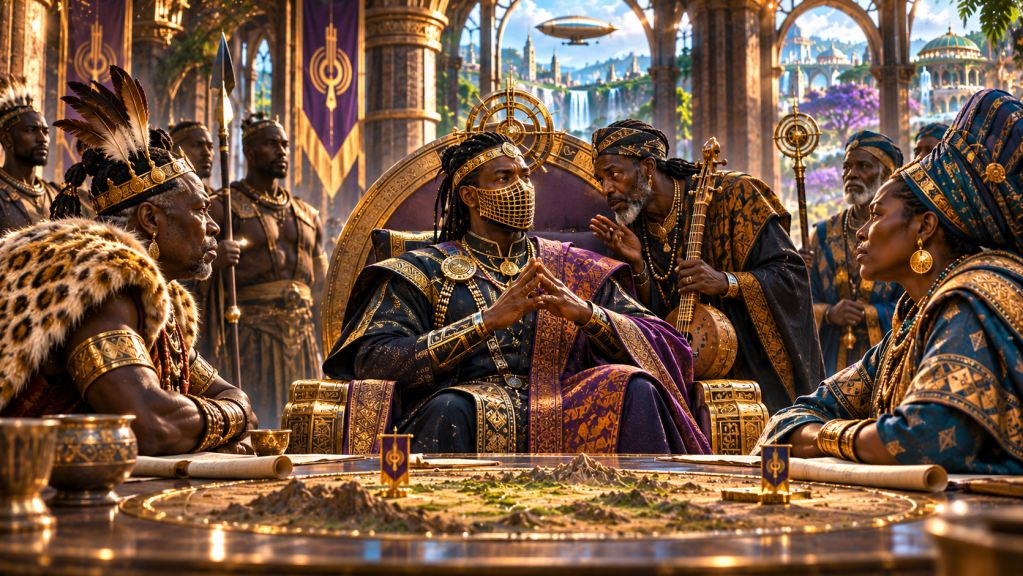
Then Yero placed that small device in Siran’s ear, and everything changed.

Siran wielded the translator like a weapon of unity, quickly finalizing building and modernization projects. Inter-kingdom negotiations, once mired in mistranslation and ritual offense, were reduced to clarity—simple words, precise understanding. As demonstrations of the device spread across the empire, economic activity surged, swelling Ndwomaran coffers beyond capacity.
Everything became easier.
Trade streamlined in regions dense with ethnic diversity. The influx of cultures strengthened the Song, where once that same diversity had been a constant source of strife and misunderstanding. As prosperity rose, resistance faded. The two kingdoms clamored for greater access and, with little hesitation, agreed to join the empire—imperial broadcasts included.


Leave a Reply